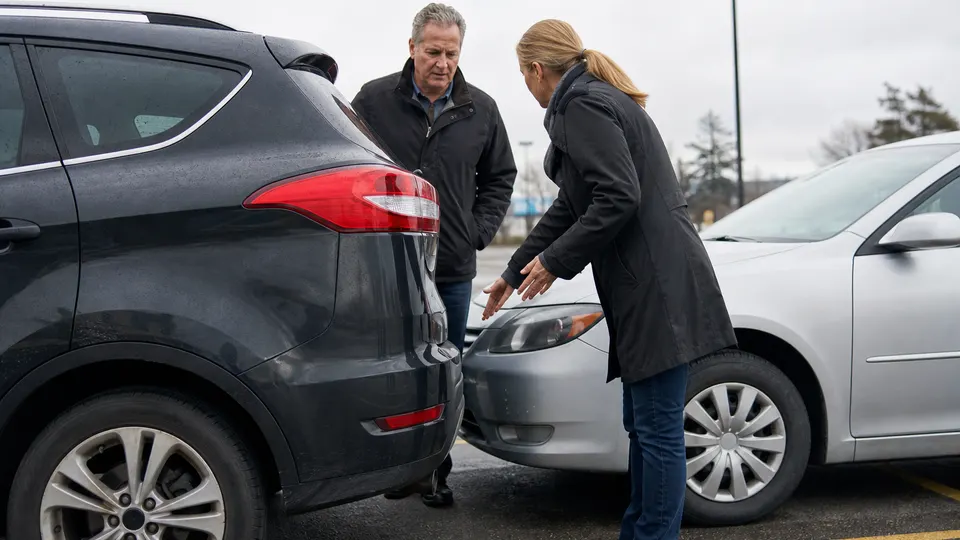
After a collision in Ontario, drivers exchange information, photograph damage, and wait for insurers to decide fault — a determination with direct financial consequences under the province's no-fault property damage system. Ontario Regulation 668 — Fault Determination Rules — assigns fault percentages for common accident scenarios: rear-end collisions, intersection turns, parking lot incidents, and lane changes. Your fault allocation affects whether you pay collision deductible, whether your insurer pursues subrogation against the other driver's insurer, and sometimes renewal pricing — even though not-at-fault drivers receive property damage repairs through Direct Compensation-Property Damage coverage from their own insurer.
Understanding FDR mechanics demystifies adjuster decisions and helps you document scenes supporting accurate fault assignment.
Direct Compensation-Property Damage (DCPD)
Since DCPD reforms, not-at-fault Ontario drivers claim vehicle property damage through their own insurer — not the at-fault driver's liability coverage. Your insurer pays repairs minus deductible if you are partially or fully not at fault per FDR; deductible may be waived or recovered if you are zero percent fault depending on policy and subrogation outcome.
DCPD speeds repairs by eliminating cross-insurer collection for property damage at claim outset — subrogation happens behind the scenes between insurers.
How Fault Determination Rules work
FDR provides diagram-based rules for scenario categories. Examples under simplified summary — always refer to official regulation for precise application:
- Rear-end collision: Following driver typically 100 percent at fault unless lead driver reversed unlawfully.
- Left turn across traffic: Turning driver typically at fault against oncoming through traffic.
- Lane change collision: Driver entering lane often faulted for failing to ensure safe movement.
- Intersection with signs: Driver failing to obey signal or stop sign faulted.
Fault can split — 50/50 or 25/75 — affecting deductible responsibility and recovery amounts.
| Scenario | Typical fault assignment | DCPD impact on you if not at fault |
|---|---|---|
| Hit from behind while stopped | Other driver 100% | Your insurer pays repair; deductible may be recovered |
| Left turn collision | Turning driver faulted | Through driver claims DCPD from own insurer |
| Parking lot backup | Both may share fault | Partial deductible per fault percentage |
| Slip on ice single vehicle | Often no fault third party | Collision coverage applies; at-fault for rating |
| Hit and run | Unknown third party | Claim under collision or uninsured motorist — deductible applies |
Fault vs accident benefits
Fault determination for property damage under FDR is separate from accident benefits — medical and rehabilitation coverage — which pays regardless of fault for eligible injuries under Ontario's hybrid system. Serious injury lawsuits involve different fault thresholds under Insurance Act provisions — legal advice required beyond property damage scope.
Disputing fault assignment
Insurers apply FDR based on statements, police reports, witness accounts, and dashcam evidence. If you disagree with fault percentage, gather contradictory evidence — independent witness, traffic camera footage requests through police, accident reconstruction for complex cases. Internal insurer dispute process precedes ombudsman escalation.
Police fault charges — Highway Traffic Act convictions — influence but do not automatically determine insurance fault under FDR; insurers apply regulation separately.
Impact on premiums and records
At-fault collisions typically affect renewal pricing three to six years. Not-at-fault DCPD claims may still appear on industry database — some insurers surcharge not-at-fault claim frequency though regulatory restrictions evolve. Claim forgiveness endorsements protect first at-fault accident with same insurer — does not erase database entry.
"Other driver ran stop sign — FDR assigned them one hundred percent fault. My deductible refunded after subrogation closed eight months later." — Driver, Hamilton, 2025
Documentation at scene
- Photograph vehicle positions before moving if safe.
- Collect witness contact information beyond other driver.
- Note weather, road markings, traffic control devices.
- File police report when injuries or significant damage — thresholds vary by municipality.
- Do not admit fault at scene — describe facts to insurer later.
Rental vehicle and loss of use
DCPD covers vehicle damage; OPCF 20 loss of use or rental coverage provides transportation while repairs proceed — not automatic on all policies. At-fault driver may lack rental coverage on minimal policy while still liable through FDR for your damage via DCPD to your insurer.
Out-of-province collisions involving Ontario drivers
Collisions outside Ontario invoke different fault regimes — Ontario FDR does not apply in Quebec or Michigan accidents. Your policy's out-of-province coverage and collision sections respond per wording; fault determined under local law affecting subrogation complexity.
Working with adjusters
Cooperate promptly; provide consistent statements. Ask adjuster to cite FDR rule number applied to your scenario. Request subrogation update if awaiting deductible recovery from at-fault insurer.
Ontario fault determination is rule-based, not subjective roadside negotiation. Know DCPD flows through your insurer, FDR assigns percentages by scenario, and documentation at scene shapes which rule applies — protecting both repair timeline and deductible recovery when you are innocent in the collision.